Why Embryology Labs Are at the Center of IVF Digital Transformation
Embryology labs are the most data‑intensive and risk‑sensitive environments within an IVF clinic. Every action taken inside the lab, from gamete identification and fertilization to embryo grading and cryopreservation, directly influences clinical outcomes, patient trust, and regulatory compliance.
Despite this critical role, many IVF labs still operate on a mix of paper registers, Excel sheets, legacy lab software, and disconnected EMR systems. While these tools may appear functional, they fail to support the complexity, scale, and accountability of modern IVF labs demand. Digitizing embryology lab workflows is not simply about replacing paper with software. It requires re‑engineering how data flows, how traceability is enforced, how procedures are standardized, and how compliance is embedded into daily operations. This in‑depth blog explores the real operational challenges of IVF lab management, explains why partial digitization often fails, and details how integrated IVF lab management systems address traceability, accuracy, scalability, and staff efficiency at a foundational level.
Understanding the True Complexity of Embryology Lab Workflows
An embryology lab workflow spans multiple tightly coupled processes, each with zero tolerance for error. These processes are not isolated tasks but interdependent stages where data accuracy, timing, and accountability must be preserved continuously.
Gamete receipt, verification, and identification are the first and most critical control points. Oocytes and sperm samples are received, verified against patient identity, and assigned unique identifiers. In manual environments, visual checks and handwritten labels dominate this step, making it highly vulnerable during peak workloads. Any error introduced here propagates throughout the entire cycle, creating irreversible traceability risks.
Fertilization methods (IVF, ICSI) and documentation represent a second layer of complexity. Each fertilization event must capture the method used, exact timing, environmental conditions, and embryologist’s responsibility. When documentation is delayed or fragmented across systems, critical procedural context is lost, weakening both clinical review and audit readiness.
Day‑wise embryo culture observationsgenerate dense longitudinal data. Embryo development must be recorded consistently across multiple days using standardized criteria. Free‑text notes and inconsistent observation timing introduce subjectivity, reducing comparability across cycles and embryologists.
Grading, selection, and clinical decision support depend on the availability of complete developmental histories. When lab data is siloed from clinical systems, decisions are made using partial information, increasing reliance on memory or static summaries rather than evidence‑based insights.
Cryopreservation, storage mapping, and thaw planning introduce long‑term traceability challenges. Embryos may remain in storage for years, often across staff changes and system upgrades. Manual cryo registers and static storage maps degrade over time, increasing risk during audits or retrieval.
Cross‑team coordination with clinicians and nursing staff is the final dependency. Embryology labs do not operate in isolation. Without integrated systems, communication relies on verbal updates or messages, creating delays and misalignment at critical decision points.
In manual or semi‑digital environments, data continuity breaks easily. Information is copied between systems; handwritten notes are transcribed later, and critical context is lost. These breakdowns are not operational inconveniences; they are clinical and compliance risks.
Why IVF Labs Need More Than Just a Spreadsheet
Challenge 1: Traceability Is Not Just Tracking, It Is Contextual Integrity
Traceability in IVF labs is often misunderstood as basic sample tracking. True traceability requires maintaining contextual integrity, knowing not just where a sample is, but how, when, by whom, and under what conditions every action occurred.
Where manual traceability breaks down
- Sample identifiers were recorded inconsistently across documents
- Handovers between embryologists lack standardized confirmation steps
- Time gaps between procedures and documentation
- Inability to reconstruct the full lifecycle of an embryo during audits
These gaps become especially dangerous during high‑volume days, staff rotations, or multi‑site operations.
How integrated digital traceability works
Advanced IVF lab management software enforces traceability by:
- Assigning persistent digital identities to gametes and embryos
- Binding observations, actions, timestamps, and users to each entity
- Preventing workflow progression without mandatory verification steps
- Maintaining immutable audit trails across the full lifecycle
This shifts traceability from manual responsibility to a system‑enforced safeguard.
IVF Lab Management Software – Complete Guide
Challenge 2: Manual Errors Are Often System Failures, Not Human Failures
Embryologists are highly skilled professionals, yet manual systems place them in error‑prone environments. Repetitive data entry, context switching between tools, and delayed documentation significantly increase cognitive load.
Common error vectors in non‑integrated labs
- Transcription errors between paper and digital systems
- Missed data fields during peak workload periods
- Inconsistent terminology across embryologists
- Duplicate or conflicting records across systems
Blaming individuals ignores the root cause: systems that do not support human workflows.
How digital systems reduce cognitive load
Integrated lab platforms reduce error probability by:
- Capturing data at the point of action
- Using structured, standardized data models
- Auto‑populating downstream records
- Validating entries in real time
This transforms documentation from a retrospective task into an embedded workflow component.
IVF Digital Transformation Challenges
Challenge 3: Lack of Standardization Undermines Quality and Scalability
Without standardized workflows, IVF labs rely heavily on individual experience. While expertise is valuable, variability introduces risk, especially as clinics scale.
Operational impact of non‑standardized lab practices
- Inconsistent embryo grading methodologies
- Variable timing of observations
- Difficulties onboarding new embryologists
- Reduced reproducibility of outcomes
Digital SOPs as operational infrastructure
Modern IVF lab management systems embed SOPs directly into workflows by:
- Defining step‑wise lab protocols
- Enforcing mandatory checkpoints
- Standardizing observation windows
- Ensuring uniform execution across staff and locations
Standardization does not remove professional judgment, it ensures that judgment operates within a controlled, repeatable framework.
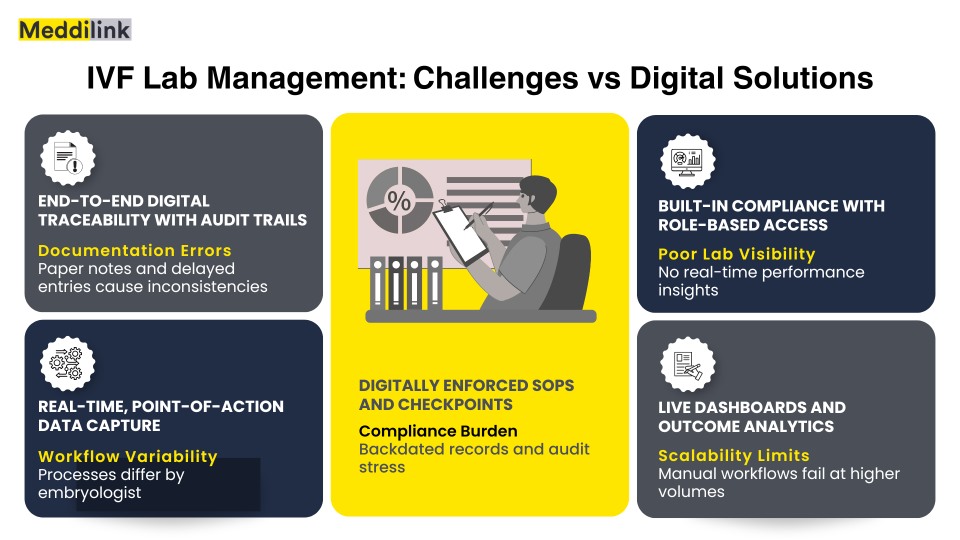
Challenge 4: Compliance Is a Continuous State, Not an Audit Event
Regulatory compliance in IVF labs is often treated as a periodic requirement rather than a continuous operational state. Manual systems encourage reactive compliance.
Compliance risks in fragmented systems
- Backdated or incomplete records
- Inconsistent access control
- Difficulty proving data integrity
- Stressful audit preparation cycles
How digital systems operationalize compliance
Integrated IVF lab management platforms:
- Enforce role‑based access at every step
- Automatically timestamp all actions
- Maintain version‑controlled records
- Enable rapid, structured audit exports
Compliance becomes an outcome of daily operations, not an additional burden.
Challenge 5: Limited Data Visibility Restricts Continuous Improvement
Manual reporting prevents IVF labs from learning systematically from their own data.
Limitations of manual lab analytics
- Lag between cycle completion and analysis
- Inability to correlate lab variables with outcomes
- Limited benchmarking across embryologists or clinics
Data‑driven embryology lab management
Digitized lab systems enable:
- Real‑time visibility into lab KPIs
- Trend analysis across cycles and protocols
- Identification of process bottlenecks
- Evidence‑based quality improvement initiatives
This shifts labs from reactive troubleshooting to continuous optimization.
Manual vs Digitized IVF Lab Workflows: A Practical Comparison
Aspect Manual / Semi-Digital Lab Digitized Integrated Lab System
Sample Traceability Relies on paper labels, spreadsheets, and visual checks; prone to human error System-enforced unique identifiers with end-to-end digital audit trails
Documentation Retrospective data entry; inconsistent formats across embryologists Real-time, structured data capture embedded into workflows
Workflow Consistency Depends on individual experience and memory SOP-driven, standardized workflows enforced by the system
Compliance Readiness Audit preparation is manual and reactive Compliance is continuous with automatic timestamps and logs
Data Visibility Limited reporting; delayed insights Real-time dashboards and outcome analytics
Scalability Breaks down as cycle volume or locations increase Designed to scale across cycles, teams, and clinics
This comparison highlights why partial digitization rarely delivers meaningful risk reduction or efficiency gains. Without workflow-level integration, manual weaknesses persist under a digital veneer.
Why Partial Digitization Often Fails IVF Labs
Many clinics digitize in silos, lab software disconnected from EMRs, reporting tools separate from workflows; compliance handled offline.
Partial digitization results in:
- Duplicate data entry
- Fragmented traceability
- Limited operational insight
- Persistent manual workarounds
True transformation requires end‑to‑end integration across clinical, lab, and operational systems.
How Integrated IVF Lab Management Systems Enable Scalable Excellence
An integrated IVF lab management system unifies:
- Embryology workflows
- Clinical data
- Compliance controls
- Analytics and reporting
Key outcomes include:
- Reduced operational risk
- Higher staff efficiency
- Scalable multi‑location operations
- Stronger regulatory posture
How Platforms Like MedART Support Integrated IVF Lab Management
Modern IVF platforms such as MedART are designed to address these challenges through end-to-end integration rather than isolated modules. By unifying embryology lab workflows with clinical EMR data, compliance controls, and reporting layers, integrated systems help clinics operationalize traceability, standardization, and audit readiness within daily lab activity.
Instead of treating lab management as a standalone function, platforms like MedART position the embryology lab as a connected, data-driven core of the IVF clinic, enabling safer operations, higher staff efficiency, and scalable growth without increasing operational risk.
Conclusion: Digitizing Embryology Labs Is a Strategic Clinical Investment
Digitizing embryology lab workflows is not about adopting software; it is about redesigning how IVF labs operate under complexity, scale, and scrutiny.
Clinics that invest in integrated IVF lab management systems build safer, more efficient, and more resilient operations. Those who delay remain constrained by manual risk and operational fragility.
In a field where precision defines success, digital maturity in the embryology lab is no longer optional, it is foundational to sustainable IVF care.
Topics