
The IVF industry is entering a defining decade. Demand is rising, treatment cycles are becoming more complex, patients expect faster communication, and competition is intensifying across regions. Yet despite this momentum, many clinics still find themselves slowed down by operational gaps, fragmented data, and outdated clinical workflows.
A recent report in Fertility & Sterility highlighted that IVF digital transformation in reproductive medicine is no longer a technical choice; it is a clinical necessity. Clinics that modernize can capture richer data, improve consistency, reduce cycle delays, and build better patient trust. Meanwhile, clinics that delay modernization face growing inefficiencies and operational risks.
But transformation is rarely straightforward.
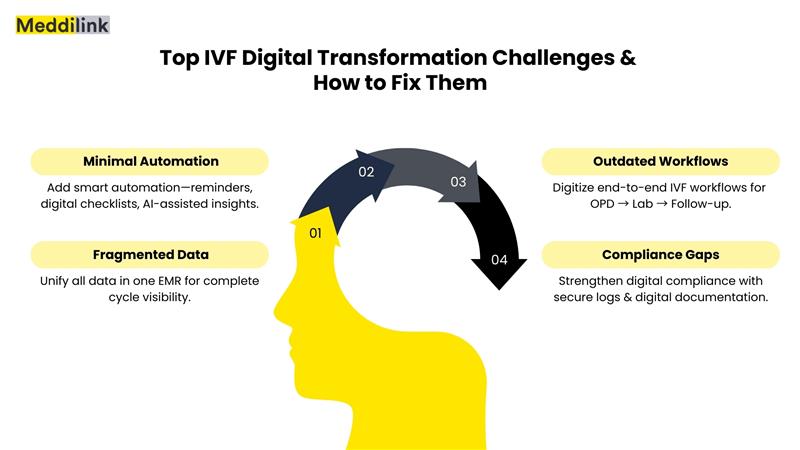
This blog breaks down the five major IVF Digital Transformation Challenges, using a clear problem–solution approach, backed by insights from your shared references.
It also explains how Meddilink (and MedART) helps clinics overcome these real-world bottlenecks.
-
Problem: Fragmented Data Across Systems Creates Blind Spots in Patient Cycles
Most IVF clinics run on multiple disconnected tools—Excel sheets, standalone lab systems, paper files, WhatsApp communications, and separate billing software. This fragmentation creates:
- Incomplete cycle histories
- Manual duplication of data
- Delayed decision-making
- Inability to analyze past cycles
- Difficulty maintaining consistency across teams
According to Fertility & Sterility, IVF now generates more data than ever before, from stimulation monitoring to lab-stage inputs, yet very few clinics manage this data in a unified way.
Solution: Build a Single Source for Every Cycle
This begins with adopting an EMR ecosystem designed specifically for ART workflows. A well-integrated system should centralize:
- Patient registration
- Stimulation protocols
- Lab-stage observations
- Consent and legal documentation
- Billing and financials
- Outcome tracking
➡️ Where Meddilink Helps:
Meddilink eliminates data silos by connecting patient, clinical, lab, and financial data in one place.
This ensures every doctor, coordinator, and embryologist has real-time access to the exact same information, reducing cycle confusion and ensuring continuity of care.
-
Problem: Limited Adoption of AI and Automation Slows Down Decision Making
While other medical fields rapidly adopt automation, many IVF clinics still rely heavily on manual processes. Common issues include:
- Manual status updates between teams
- Manual calculation or tracking of cycle parameters
- Paper-based checklists
- Inconsistent documentation styles
- Delayed communication during stimulation and lab stages
This slows down workflows and increases the dependency on a few individuals.
Solution: Adopt Practical, Non-disruptive AI and Automation
Clinics don’t need high-cost automation to start benefiting from digital tools. Automation can begin with:
- Auto-generated cycle summaries
- Automated reminders
- Smart task routing
- Auto-updated lab checklists
- Digital stimulation tracking
- Centralized communication dashboards
➡️ How Meddilink Supports This:
Meddilink’s MedAI-X introduces intelligent automation that fits into the clinic’s existing workflow, enhancing, not replacing, clinical insight.
This gives doctors and embryologists faster clarity, reduces manual effort, and ensures high data accuracy.
-
Problem: Legacy Clinical & Lab Workflows Reduce Efficiency and Productivity
Even today, many IVF clinics face bottlenecks such as:
- Cycle files circulating between multiple departments
- Delayed reporting from the lab to clinicians
- Miscommunication during the stimulation window
- No standardized workflow structure
- High reliance on specific individuals for cycle progress
According to LifeLinkr’s operational insights, workflow fragmentation is one of the biggest contributors to cycle delays, inefficient staff utilization, and lower patient satisfaction.
Solution: Standardize and Digitize the Full IVF Workflow
Successful clinics adopt digital-first workflows that clearly define:
- Task ownership
- Timelines per cycle stage
- Checklists and quality checkpoints
- Cross-department communication paths
- Automated cycle handovers
➡️ How Meddilink Improves This:
Meddilink digitizes the entire workflow from OPD to stimulation to lab processes to follow-up.
Each team member sees exactly what needs to be done, by whom, and by when, ensuring smooth, coordinated cycles.
This drastically reduces delays and eliminates inconsistencies between teams.
-
Problem: Compliance, Audit Trails & Data Security Are Difficult to Maintain Manually
ART regulations require strict documentation—from consent forms to stimulation logs and lab traceability.
Without digital systems, clinics struggle with:
- Missing records
- Outdated consent forms
- Incorrect or incomplete documentation
- Limited audit trails
- Increased risk during inspections
- Vulnerability to data loss or breaches
Fertility & Sterility emphasizes that digital traceability significantly reduces regulatory and medico-legal risks, especially in sensitive domains like IVF.
Solution: Strengthen Digital Compliance and Documentation
A modern EMR built for IVF should offer:
- Encrypted patient data
- Region-specific legal compliance
- Automated audit trails
- Controlled access levels
- Standardized documentation formats
- Secure cloud backups
➡️ How Meddilink Ensures Compliance:
Meddilinkmaintains complete cycle audit logs, offers role-based permissions, and automates documentation to ensure clinics pass inspections confidently.
With digital consents and secure records, compliance becomes structured—not stressful.
-
Problem: Resistance to Change Prevents Clinics from Scaling Digitally
Even when software is adopted, many teams struggle with:
- Fear of new systems
- Habits built around manual workflows
- Concern about the time required to adapt
- Misalignment between management and clinical teams
- Limited training on new tools
- This challenge is human, not technical.
Solution: Lead Digital Transformation as a Cultural Shift
Successful digital adoption begins with:
- Clinic leadership communicates a clear vision
- Role-based onboarding
- Phased implementation
- Incremental adoption of advanced features
- Continuous feedback loops with the vendor
- Training tailored to doctors, embryologists, and front-office staff
➡️ How Meddilink Handles This Seamlessly:
Meddilinkprovides structured onboarding, simplified training, and continuous support.
Teams adapt at their own pace, ensuring no disruption to ongoing cycles and clear buy-in from all stakeholders.
Final Thoughts: Digital Transformation Is Now the Foundation of Clinical Excellence.
The clinics that succeed will be the ones that:
- Eliminate data silos
- Adopt automation meaningfully
- Standardize workflows
- Build secure digital compliance
- Invest in team adoption and cultural change
This isn’t about technology alone; it’s about creating a more reliable, transparent, and scalable IVF practice.
➡️ Meddilinkand MedART help IVF clinics transition into digital-first, AI-enabled, compliant, and workflow-optimized environments.
The goal is simple: better cycle management, stronger patient experience, and measurable operational efficiency.

Topics