
For an IVF clinic owner, success isn’t only measured in births. It’s measured in trust. Every patient who walks in is entrusting you with deeply personal and sensitive information — their fertility history, partner or donor details, genetic screening results, and even their hopes and anxieties. In an age where digital records are the default, keeping that data safe is no longer optional.
That’s why choosing an EMR with strong data protection is a business-critical decision. Your EMR must not just store data, it must shield it, protect it, and prove to every stakeholder that you take privacy seriously.
Why IVF Clinics Are Uniquely Vulnerable
1. Heightened Sensitivity of IVF Data
IVF clinics deal with a level of patient data sensitivity that goes beyond most general practices. It’s not just diagnoses and prescriptions; you store partner profiles, donor information, detailed lab reports (embryo development, genetic tests), consent forms, and pregnancy plans. Losing or exposing any of this can have profound personal and legal repercussions.
2. Healthcare Is Among the Most Targeted Industries
Data from the 2025 IBM Cost of a Data Breach Report highlights how vulnerable healthcare is: the average cost of a breach in the healthcare sector is US $ 7.42 million. (TechTarget). Even though that’s a drop from prior years, it remains the most expensive industry to breach. (The HIPAA Journal). For IVF clinics, which handle deeply personal data, that cost can translate into business disruption, trust loss, and potentially regulatory fines.
3. Time to Detect & Contain Breaches Is Long
The same report shows that the average “breach lifecycle”, the time taken to identify and contain a breach, is 279 days for healthcare organizations. (The HIPAA Journal). That’s more than five weeks longer than the global average of 241 days. (Help Net Security). Long dwell time gives attackers more opportunity to exfiltrate data, magnifying the risk for clinics.
What Makes an EMR Truly Secure: Defining “Strong Data Protection”
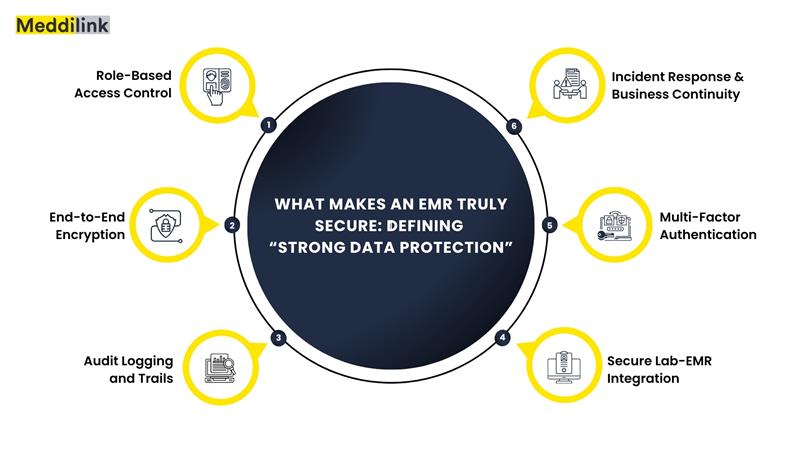
It’s not enough for an EMR to claim “security”; as a clinic owner, you need to know what “strong data protection” really means. Here are the non-negotiable features:
A. Role-Based Access Control (RBAC)
Access only to what is strictly required: embryologists see lab reports, admin sees appointment history, doctors see patient notes. Minimizes exposure in case credentials are compromised. Helps enforce the “least privilege” principle.
B. End-to-End Encryption
Data should be encrypted at rest (on servers) and in transit (when being transferred). Even in the case of a breach, encrypted data is useless without the keys. Proper key management is critical; this is a common weak point.
C. Audit Logging and Trails
Record who accessed what, when, and what they did (view, edit, delete). Critical for compliance, forensic investigation, and risk monitoring. For IVF clinics, audit logs are especially important because of sensitive consent records, donor/partner data, and lab history.
D. Secure Lab-EMR Integration
Labs are a major data source in IVF (hormone tests, embryo grading, genetic reports). Your EMR must securely integrate with lab systems, avoiding data leaks in transmission. Use of APIs, secure file exchange protocols, and encryption ensures that lab data doesn’t become a weak link.
E. Multi-Factor Authentication (MFA)
Adds a second layer of protection beyond passwords (SMS, authenticator app, hardware tokens). Prevents unauthorized access, even if login credentials are compromised.
F. Incident Response & Business Continuity
Plan and practice how to respond to a breach: detection, isolation, notification, and recovery. Your EMR vendor should provide features to support quick data access and recovery, even during a security incident. Regular backups (encrypted) and disaster recovery drills should be part of your operations.
Compliance & Governance: Why Strong Data Protection Helps You Stay on the Right Side of the Law
As a clinic owner, data protection isn’t just good practice; it’s often legally required:
- HIPAA / Local Regulations: Depending on location, you must comply with patient data regulations. Encryption, audit logs, and access controls help you meet those standards.
- Audit Readiness: With a secure EMR, you’re ready for data audits — logs and access history make it easier to prove compliance.
- Consent Management: IVF involves consents (partners, donors) — storing signed digital consents securely is essential. An EMR with good data protection helps you manage, retrieve, and retain these securely.
Real-World Cost & Brand Impact for IVF Clinics
Financial Risk
A data breach isn’t just a security incident — it’s a business event. Healthcare breaches cost millions: US $ 7.42 million on average in 2025. (The HIPAA Journal) On a per-record basis, the cost can vary. According to Total Assure’s analysis of IBM / Ponemon data, healthcare data breach per-record cost is about US $ 142. (Total Assure) For IVF clinics, where patient data is richly detailed, high per-record cost means each patient record is a potential major financial risk.
Reputational Risk
In recent times, even fertility providers have been targets. For example, Genea, an Australian IVF provider, was reported to have had patient data compromised. The Guardian Patients in fertility treatment are particularly sensitive; a data breach undermines trust severely and can drive them to competitors.
Operational Disruption
Breaches often lead to downtime, investigations, and notifications, all of which can disrupt clinic workflows. When your EMR is compromised, lab workflows, scheduling, patient communication, everything slows down.
What IVF Clinic Owners Can Do Right Now: A Practical Action Plan
Here’s a roadmap for IVF clinic owners who want to choose and implement an EMR with strong data protection:
Ask the Right Questions During Selection
During vendor demos, focus on security: “How is data encrypted?”, “Do you support role-based access?”, “Is there an audit trail?” Request a security architecture whitepaper or SOC report.
Budget for Security as Part of EMR Cost
Security features (encryption, MFA, audits) aren’t extra; they’re critical. Include incident response planning and backup strategies in your budget.
Train Your Team
Security isn’t just tech: train embryologists, nurses, and admin staff on data hygiene. Simulate phishing attacks and practice incident response.
Define Access & Governance Policies
Who in your clinic has access to what? Create clear role definitions. Set up policies for periodic review of user access and privileged accounts.
Implement Incident Response Procedures
Document what to do if there’s a breach. Run tabletop exercises to practice detection, containment, and recovery. Make sure your EMR vendor supports log export, backup recovery, and isolation of compromised accounts.
Continuity & Resiliency
Maintain encrypted backups. Have a disaster recovery plan: how to keep essential operations running if your EMR is offline. Test recovery regularly.
Audit & Review
Regularly review audit logs for suspicious activity. Perform security reviews every 3–6 months. Update/enforce encryption keys, rotate credentials, and review access privileges.
Looking Ahead: The Future of Data Protection in IVF EMRs
AI & Automation: Some EMRs are beginning to leverage AI to detect anomalous access patterns (e.g., someone downloading an unusually large number of patient files).
Blockchain / Immutable Logs: Emerging research suggests blockchain could be used to build tamper-proof audit trails.
Cloud Security Innovations: As clinics move to cloud-based EMRs, strong cloud-native encryption, zero-trust models, and secure key management will become more important.
How Modern IVF EMRs Are Evolving, A Look at Meddilink’s MedART Approach
As IVF clinics scale and workflows grow more interconnected, the definition of an EMR with strong data protection is expanding. Clinics no longer need just a digital filing system, they need a secure, integrated backbone that connects patient intake, lab processes, consent workflows, cryo-storage records, and clinician decisions in one protected environment.
This is where platforms like Meddilink’s MedART illustrate how modern IVF EMRs are adapting to today’s data security demands.
MedART’s architecture is built around three core principles IVF clinics care about most:
1. Controlled Access Across Every Step of the IVF Journey
MedART utilizes strict role-based permissions, ensuring that embryologists, doctors, nurses, and administrative teams only see what is relevant to their respective responsibilities. This reduces unnecessary data exposure and keeps sensitive fertility information protected at every point of interaction.
2. Secure, Encrypted Communication Between Lab & Clinical Modules
A major vulnerability in many IVF setups comes from disconnected lab systems. MedART minimizes this risk by enabling secure, encrypted information flow between embryology data, stim protocols, genetic testing reports, and patient records, ensuring that lab insights move safely without manual transfers or external tools.
3. Built-In Compliance Readiness
Instead of adding compliance as an afterthought, MedART incorporates audit trails, encrypted storage, consent tracking, and secure backup practices as part of its default framework.
This helps clinics stay aligned with regional privacy laws and international healthcare standards without additional effort.
By weaving security into everyday workflows, MedART reflects how the next generation of IVF EMRs is evolving: less manual work, fewer system gaps, stronger patient trust, and protection by design.
Your Choice of EMR Is a Statement on Safety
As an IVF clinic owner, choosing an EMR with strong data protection is about more than just ticking a compliance box, it’s a powerful statement to your patients and your team that their sensitive information matters.
Investing in a secure, well-architected EMR does more than reduce risk. It helps you build trust, maintain operational stability, and protect your reputation. In a business built on intimate, life-changing journeys, data protection isn’t just a technical burden; it’s part of the care you give.