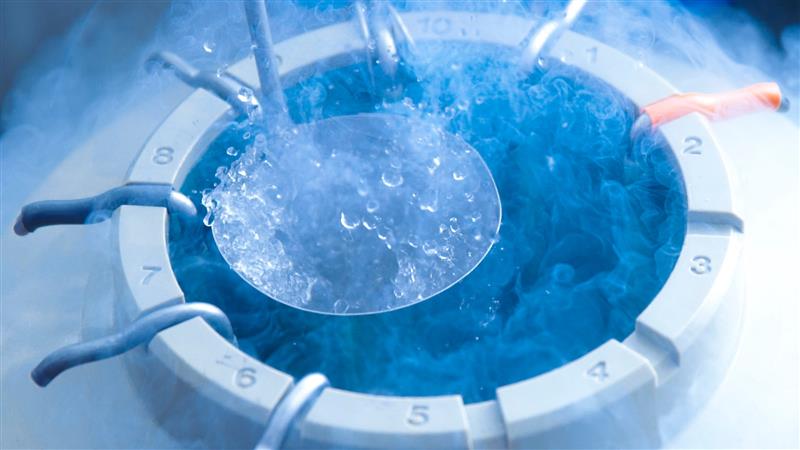
In recent years, fertility preservation has become one of the most transformative advancements in reproductive medicine. Once a procedure limited to oncology patients, it has now evolved into a proactive option for women and couples who wish to delay parenthood for medical, professional, or personal reasons.
Across Asia, fertility preservation programs are seeing exponential growth. Clinics in India, Singapore, Thailand, and the Middle East are witnessing an increasing number of women opting to freeze their eggs in their 20s and 30s. This reflects a major shift in how individuals view reproductive planning, emphasizing autonomy, flexibility, and preparedness.
However, this rising demand has also introduced new operational challenges for clinics. Unlike a standard IVF cycle that concludes within weeks, fertility preservation is a long-term commitment, spanning years or even decades. Clinics must now manage not only the initial stimulation and freezing process but also ongoing data tracking, consent renewals, storage logistics, and legal compliance.
As Johns Hopkins Medicine explains, the egg-freezing process involves “multiple complex stages, hormonal stimulation, egg retrieval, cryopreservation, and long-term storage, each requiring precise documentation and coordination” (Johns Hopkins Medicine).
These complexities make one thing clear: traditional EMRs and manual systems are no longer enough. Clinics need specialized software for fertility preservation management platforms built to handle the unique lifecycle of preserved reproductive material with accuracy, accountability, and scalability.
The Growing Challenge for IVF Clinics
Fertility preservation brings immense opportunity but also a different operational DNA compared to conventional IVF. Here’s why.
- Long-Term Data Responsibility
When clinics freeze eggs or embryos, they don’t just preserve biological material; they assume long-term data stewardship. Each sample represents years of traceable information: consent forms, retrieval and freezing reports, cryostorage logs, renewal agreements, and future utilization records. Managing this manually creates room for inconsistency and compliance risks.
-
Storage Complexity
Cryostorage facilities can hold thousands of samples stored in multiple tanks, canisters, and straws, each with distinct metadata. Without a digital mapping system, identifying the location of a specific oocyte becomes a laborious process that increases the risk of human error. For clinics scaling up, this can quickly become unmanageable.
-
Consent Renewal and Communication
Every preserved sample carries legal and ethical obligations. Patients must renew storage consent and payment periodically. A missed renewal can lead to disputes, or worse, accidental discarding of samples. Many clinics still rely on spreadsheets or reminders, which are neither secure nor scalable.
-
Compliance and Traceability
Authorities across Asia are increasingly tightening reproductive regulations, requiring clear documentation of every movement and condition of stored material. In such an environment, having digital traceability is not a luxury, it’s a necessity.
In essence, the challenge isn’t medical—it’s information management. Clinics must synchronize biological processes, administrative documentation, and patient communication in one cohesive system. That’s where specialized fertility preservation software redefines what efficiency means in an IVF setting.
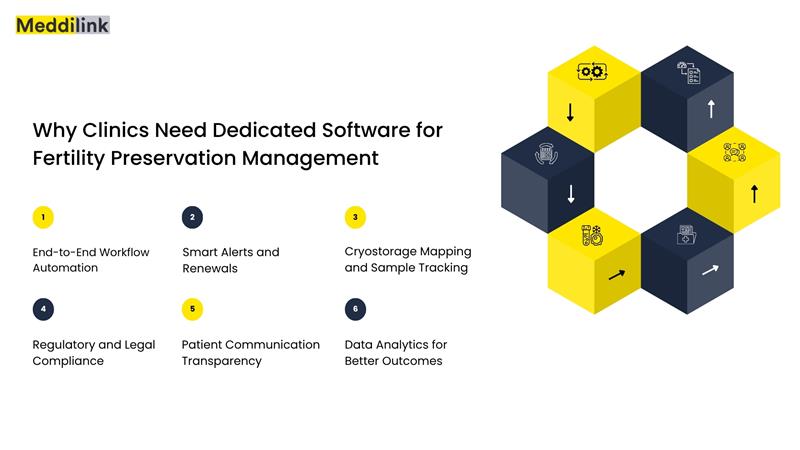
Why Clinics Need Dedicated Software for Fertility Preservation Management
Traditional EMRs handle patient visits and IVF cycles well, but they’re rarely designed for the long-term, storage-intensive nature of fertility preservation. Dedicated software for fertility preservation management fills this gap by bringing automation, structure, and intelligence into every stage of the process.
-
End-to-End Workflow Automation
From ovarian stimulation through cryopreservation and eventual thawing, each action can be logged automatically. The software ensures that no step from consent documentation to tank placement is missed. Automated timestamps create a verifiable trail that supports both internal quality audits and regulatory inspections.
-
Smart Alerts and Renewals
Renewal management is one of the most tedious yet critical tasks in preservation programs. Dedicated software automates reminders for both patients and staff, alerting them ahead of storage expiration dates, payment renewals, or consent lapses. This drastically reduces administrative load and eliminates manual oversight errors.
-
Cryostorage Mapping and Sample Tracking
Digital mapping tools visualize tanks, racks, and samples in real time. Each oocyte or embryo can be tracked through barcode or RFID tagging. This not only minimizes the risk of misplacement but also speeds up retrieval and audit processes.
Clinics can even monitor tank capacity and environmental conditions, ensuring sample safety and operational efficiency.
-
Regulatory and Legal Compliance
Compliance requirements vary across countries, but the fundamentals remain the same: clinics must demonstrate traceability, consent validity, and ethical storage. Digital logs automatically capture every transaction, making it easier to present clear documentation during audits or legal reviews.
-
Patient Communication and Transparency
Modern preservation programs depend on patient trust. Software integrated with patient portals allows clients to receive timely updates, consent forms, and payment alerts. This level of transparency not only reassures patients but also builds long-term relationships, a competitive differentiator for clinics.
-
Data Analytics for Better Outcomes
Preservation management software turns raw data into actionable insights. Clinics can analyze trends such as survival rates, renewal percentages, and utilization patterns. These insights enable more accurate forecasting, effective patient education, and informed operational decisions.
When combined, these capabilities transform fertility preservation from a manual process into a data-driven, scalable, and patient-centric service.
How Next-Gen Solutions Like MedART Simplify It All
Managing fertility preservation efficiently requires more than just a generic EMR; it demands an integrated system that ties together patient data, laboratory workflows, and long-term cryo-storage management. That’s exactly the approach behind MedART, developed by Meddilink as the digital backbone of an IVF clinic’s preservation ecosystem.
Key Highlights of MedART for Fertility Preservation
-
End-to-End Traceability
Every gamete, embryo or tissue sample is tagged and linked to the full lifecycle from retrieval, freezing, to future use or discard. MedART enables this by logging each step with a secure timestamp and operator identity, delivering the full audit trail clinics need.
-
Cryo Renewal & Storage Mapping
The system automatically tracks storage contracts and renewal deadlines. Patients and staff receive reminders when storage fees or consents are due, reducing the risk of lapse or miscommunication. In parallel, MedART provides a visual map of canisters, tanks, and rack positions so sample location, status, and history are instantly accessible.
-
Operational Intelligence
As clinics scale, the operational load increases. MedART’s modular design supports scalability from boutique clinics managing dozens of samples to networks handling thousands. With dashboards showing renewal forecasts, storage-capacity alerts, and utilization trends, the platform positions cryo-management as a strategic, rather than purely operational, function.
-
Patient-Centric Transparency
Through integration with clinic-facing and patient-facing modules, MedART helps keep patients informed and engaged. Patients can view their stored samples, receive renewal notifications, and authorize discards with ease. This transparency strengthens trust, turning a complex process into a partnership.
By combining these capabilities, MedART bridges the gap between fertility preservation’s clinical complexity and the operational clarity clinics need. It transforms cryo-management from a back-office burden into a differentiator: enabling clinics to operate with precision, scalability, and patient-first communication.
The Value for Clinics: From Operational Control to Patient Trust
The adoption of software for fertility preservation management is not merely a technical upgrade; it’s a strategic evolution that enhances every dimension of a clinic’s operation.
Operational Excellence
Automation reduces repetitive work, freeing clinicians and staff to focus on patient care and research. With real-time data visibility, decision-making becomes faster and more accurate. Moreover, digital logs simplify internal audits, reducing the time spent preparing for inspections.
Data-Driven Insights
Centralized data allows clinics to identify trends that were previously invisible. They can evaluate how age impacts oocyte survival rates, compare freezing techniques, or measure renewal retention, enabling continuous improvement in both clinical and business outcomes.
Building Patient Trust
Patients who choose egg freezing often view it as an emotional investment in their future. They expect clarity, security, and transparency. As The Hindu highlights, the trend toward elective egg freezing stems from women “taking control of their reproductive timelines,” making communication and reliability critical.
By providing patients with access to their records, renewal reminders, and clear documentation, clinics reinforce trust, a cornerstone for long-term success.
The Future of Fertility Management is Digital
The next decade of reproductive medicine will be defined by three key forces: automation, AI, and patient personalization. Clinics that embrace these early will not only improve efficiency but also create data-rich ecosystems capable of predictive care.
Imagine a clinic where AI analyzes thousands of preservation cycles to identify optimal stimulation protocols for each patient profile. Or where cryostorage conditions are monitored in real time, with alerts sent before a deviation occurs. This is not futuristic speculation; it’s the direction leading IVF networks are already taking.
For Asian clinics, the opportunity is particularly significant. The region’s mix of technological adoption and growing demand for fertility care makes it the ideal ground for innovation. By leveraging digital tools like MedART, clinics can scale faster, operate more efficiently, and deliver higher-quality care.
Conclusion: Transforming Fertility Preservation Management
Fertility preservation represents one of the most promising frontiers in reproductive health, but its success depends on precision, transparency, and data integrity. Clinics can no longer rely on fragmented systems or manual tracking to manage processes that span years and involve such sensitive information.
Adopting software for fertility preservation management isn’t just about convenience. It’s about empowering clinics to operate with confidence, ensuring every preserved egg, every consent, and every communication is recorded, traceable, and secure.
With platforms like Meddilink’s MedART, clinics gain more than an EMR; they gain a digital backbone built for the future of reproductive medicine. From workflow automation and regulatory readiness to patient engagement and AI insights, MedART turns complexity into clarity.