
IVF isn’t just another branch of healthcare, it’s a deeply emotional journey built on precision, transparency, and trust. Every piece of data, every result, and every update matters not only to the clinician but to hopeful parents who hang onto every word.
Yet, despite advances in medical science, many IVF clinics still face one persistent challenge real-time reporting.
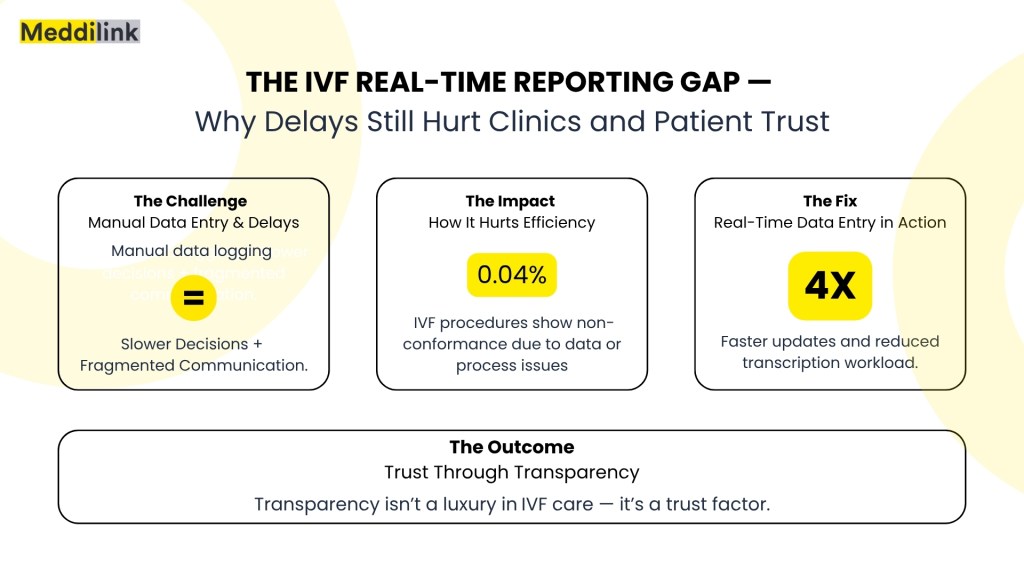
Behind every treatment cycle lies a tangled web of data: embryology logs, stimulation reports, lab results, and clinical observations. When these aren’t connected, real-time transparency becomes impossible and patient confidence begins to fade.
The Real-Time Reporting Gap: Where IVF Clinics Fall Short
Real-time reporting sounds simple data that’s instantly accessible, accurate, and visible when needed. But for most IVF clinics, achieving that is far from easy.
Many still depend on manual record-keeping or legacy EMR systems that were never designed for modern IVF workflows. Reports are often built retrospectively, not proactively. This lag creates a gap between what’s happening in the lab and what’s visible to the patient or clinical team.
It’s not uncommon for embryologists to manually enter data into spreadsheets at the end of the day, a process prone to errors and delays. And when the team can’t access real-time IVF outcome analytics, quick decision-making becomes a challenge.
The result? Critical insights arrive too late to make a real difference.
Why Traditional Systems Struggle
Most IVF reporting systems evolved as standalone tools, each handling one part of the process.
You have:
- A lab management system for embryology data.
- A patient record system for clinical notes.
- A financial system for billing and compliance.
These data silos mean clinics spend more time connecting dots than analyzing patterns. The absence of IVF lab data integration creates a fragmented ecosystem where data exists, but insights don’t.
And while manual tracking might have worked years ago, today’s IVF environment demands speed, accuracy, and transparency. The emotional and financial stakes are too high for “we’ll update you tomorrow” responses.
The Ripple Effect: Delayed Data and Declining Patient Trust
When patients go through IVF, they crave information, not just outcomes, but understanding.
Every unanswered question or delayed update erodes a bit of confidence.
Think about this:
- A patient waits days to learn about embryo grading results.
- A clinician discovers a discrepancy in hormone readings due to manual input errors.
- The lab team struggles to reconcile cycle data before an audit.
Each of these moments weakens trust. In an age where people can track a food delivery in real time, shouldn’t they also be able to track their treatment journey with the same clarity?
This is where IVF real-time reporting becomes more than a technical upgrade; it becomes a human need.
Patients equate transparency with honesty. Clinics that provide real-time updates foster reassurance and loyalty. Those who don’t often see patients quietly seek alternatives.
From Data Entry to Decision Support
The future of IVF isn’t about collecting more data, it’s about making data work intelligently.
Through IVF EMR automation, clinics can eliminate redundant entry points, ensuring every update, from the lab to the consultation room, happens in real time.
Automated reporting can:
- Streamline IVF workflow management across departments.
- Ensure immediate data syncing from lab equipment to EMR dashboards.
- Create compliance-ready audit trails automatically.
- Enable physicians to access IVF outcome analytics instantly, helping them adjust treatment strategies on the go.
When systems are connected, so are the decisions. And when decisions are fast, patients notice the confidence it inspires.
Building Transparency with Technology
Let’s imagine an IVF ecosystem where lab, clinical, and patient interfaces speak the same digital language.
A world where:
- The embryologist logs results, and the doctor sees them instantly.
- A patient portal updates in real time when milestones are reached.
- Data visualization tools make trends visible at a glance.
This isn’t a distant future; it’s what IVF lab data integration and smart EMR systems are already making possible.
By merging AI-driven insights with real-time updates, clinics can transform the patient journey into one defined by clarity, not confusion.
The Trust Dividend
Real-time reporting does more than streamline operations; it humanizes the IVF experience.
When patients receive updates in real time, they feel informed, empowered, and valued. When staff spend less time verifying data and more time engaging with patients, empathy returns to the forefront.
Trust, after all, isn’t built in a single consultation. It’s built every time a patient feels seen, heard, and updated.
The Way Forward
IVF clinics today have two paths:
Keep patching systems that struggle to talk to each other or embrace IVF real-time reporting powered by automation, analytics, and integration.
By investing in intelligent EMR systems that unify lab and clinical data, clinics don’t just modernize operations, they rebuild patient trust, one real-time update at a time. Because in IVF, every second counts and every update builds belief.
Topics