Across the world, IVF clinics juggle electronic medical records, lab systems, billing platforms, spreadsheets, and a tangle of messaging apps. At a small scale, this patchwork “works” until it doesn’t.
What clinic leaders are really struggling with is fragmented data. Patient records live in different systems. Lab results do not sync with EMRs. Billing and inventory operate in silos. Reporting is manual. Decisions are delayed.
In real terms, transcription duplication and manual logging are common in assisted-reproduction labs and be time-consuming and error-prone in clinical audits. Embryologists and coordinators report repeated data entry across spreadsheets, lab systems, and EMRs. a direct driver of inefficiency.
If you are searching for how to manage fragmented data in IVF clinics, the real answer is not another point tool. It is a connected ecosystem powered by modern IVF clinic management software.
What “fragmented data” looks like in everyday clinic operations
Fragmentation shows up in ways senior clinic staff recognize immediately:
- Patient demographics are entered separately at registration, lab, and billing.
- Embryology lab notes are recorded in standalone lab systems and mirrored in the clinic EMR.
- Protocol deviations are tracked in spreadsheets rather than audit-ready logs.
- Manual reconciliation of billing and insurance claims.
- No single dashboard for cycle-level KPI monitoring.
A 2022 clinic case study documented how manual transcription and parallel software use slowed embryo processing and increased staff workload, exactly the operational drag that prevents scale.
Why conventional software stacksfail tomanage fragmented data at scale
Standalone EMRs, lab information systems (LIS), and ad-hoc spreadsheets were built to solve single tasks, and they do those tasks well. But fertility care is a workflow: registration → stimulation → monitoring → retrieval → lab processing → transfer → follow-up. When systems are siloed, the handoffs between each step become failure points.
Consequences include:
- Increased risk of data mismatch and clinical errors. Multiple systematic reviews indicate that integrated electronic health record systems reduce medical errors and improve diagnostic reliability compared with fragmented records.
- Slower decision cycles because clinicians lack up-to-the-minute data.
- Administrative overhead: hospitals and clinics spend significant staff time reconciling records or re-entering information. Projections show a dramatic opportunity for automation to cut administrative labor in healthcare.
Defining an “intelligent IVF ecosystem” to manage fragmented data
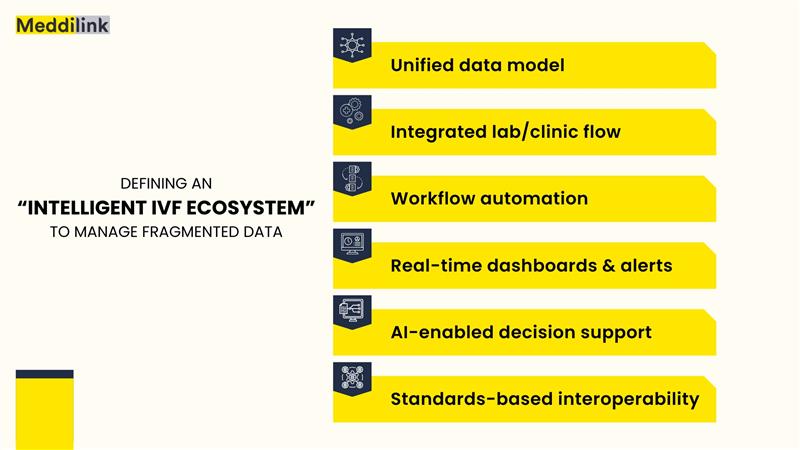
An intelligent IVF ecosystem is a platform that treats the clinic as a single operational unit, not a collection of disconnected modules. Key attributes:
- Unified data model: one canonical patient cycle record accessible by front desk, clinicians, embryologists, and finance.
- Integrated lab/clinic flow: LIS and EMR share the same identifiers, timestamps, and audit logs so the lab and clinic speak the same data language.
- Workflow automation: routine tasks (consent collection, medication reminders, sample labeling, inventory checks) are automated and tracked.
- Real-time dashboards & alerts: leadership dashboards show KPIs, cycles, success rates, cancellations — plus actionable alerts (missed meds, abnormal labs).
- AI-enabled decision support: analytics surface risk patterns, predict outcomes, and recommend protocol optimizations.
- Standards-based interoperability: APIs and FHIR/HL7 connectors keep third-party partners in sync.
- Interoperability is a core pillar: health-system publications emphasize that modern procurement and design should prioritize interoperable technologies to reduce friction in data sharing.
What the evidence says: clinical safety, efficiency, and staff well-being
Reduced error rates and better clinical documentation
Multiple reviews find EHR/EMR implementations produce measurable reductions in certain types of medical error and improve documentation quality. That effect translates directly in IVF settings where clear cycle-level records are essential to patient safety.
Time savings and reduced duplication
Clinic studies and operational reviews show that replacing transcription-heavy processes with integrated digital capture reduces repeated data entry and frees clinical staff for higher-value tasks. The 2022 IVF clinic paper documenting “real-time data recording and rolling audit” shows transcription duplication was a major pain point before integration.
Burnout & administrative relief via automation
Healthcare research suggests administrative burden is a major contributor to provider burnout. AI and workflow automation can reduce this cognitive and administrative load by handling routine documentation, triage, and scheduling tasks, allowing clinicians to focus on care. Systems that automate repetitive tasks have been proposed to address up to 80% of administrative tasks in the coming years.
The role of AI: practical use cases for IVF clinics
AI should be framed as augmented intelligence, tools that amplify clinician judgment. Useful, realistic applications for IVF clinics include:
- Predictive cycle modelling: early prediction of poor responders or hyper-response using historic and current cycle data.
- Automated alerts: medication of non-adherence, abnormal lab trends, or mismatches between patient IDs and sample labels.
- Smart scheduling: optimize OR and lab staffing across multiple cycles to reduce wait times and utilization gaps.
- Administrative assistants: AI transcription, digital scribes, and template notes that decrease charting time. These have been shown to reduce clinician documentation time and improve throughput.
Important note: AI is only as good as data quality and governance. A unified data layer and rigorous clinical validation are prerequisites.
Scaling across multiple branches: what multi-site clinics need
When an IVF group expands from one center to multiple branches, fragmented systems create exponential headaches:
- No single source for aggregated KPIs or cohort analysis.
- Inconsistent protocols across sites degrade quality and make benchmarking impossible.
- Centralized procurement and inventory become manual and error-prone.
Research on multi-site EHR studies highlights the importance of a shared data model and centralized analytics for robust multi-site research and operations.
Concrete benefits clinics report after moving to integrated IVF clinic management software
(Examples below are generalized from clinical case studies and operational reviews across fertility and other ambulatory specialties.)
- Faster cycle turnaround times: fewer delays caused by missing documentation.
- Lower administrative headcount per cycle: automation reduces repetitive tasks.
- Fewer documentation errors and near-misses: integrated logging and barcode/sample matching.
- Improved patient satisfaction: clearer communication, automated reminders, and a single patient portal for results and appointments.
- Better compliance & audit trails: digital consent forms and secure, timestamped data trails.
These gains are consistent with broader findings that EHRs and interoperable systems improve diagnostic reliability, support preventive care, and reduce process inefficiencies.
A practical checklist: what to look for when selecting IVF clinic management software
When evaluating platforms, prioritize features that solve real operational pain, not just glossy AI promises.
Core functional checklist
- End-to-end cycle management (registration → follow-up)
- Native or certified LIS integration (or robust APIs)
- Patient portal and secure messaging
- Billing, claims, and inventory modules (or seamless connectors)
- Role-based access controls and audit logging
- Data export, reporting, and BI integrations
- Standards support (FHIR, HL7) for future integrations
- Regulatory compliance (GDPR/PDPA/HIPAA as applicable)
- Localisation: language, currency, regulatory forms for your operating geographies
- Scalability and multi-tenant support for multi-branch groups
Operational & vendor assessment
- Implementation support and training programs
- Data migration track record (spreadsheets → structured EMR)
- SLA and uptime guarantees for 24/7 lab operations
- Integration partners (labs, imaging, pharmacies)
- Security certifications and third-party audits
Measuring success: KPIs every IVF clinic should track post-implementation
To prove ROI and operational improvement, track these metrics pre- and post-launch:
Operational KPIs
- Average administrative hours per cycle (target: decrease)
- Time from retrieval to lab logging (target: decrease)
- Sample mismatch incidents / near misses (target: zero)
Clinical KPIs
- Cycle cancellation rate due to admin or logistics (target: decrease)
- Time to decision for protocol changes (target: decrease)
Business KPIs
- Revenue per cycle (monitor impact as throughput improves)
- Billing claim rejection rate (target: decrease)
- Patient satisfaction / Net Promoter Score (NPS) (target: increase)
Collecting these baselines before implementation enables meaningful comparisons.
- Implementation playbook — pragmatic steps that reduce risk
- Map current workflows end-to-end (include paper and spreadsheet handoffs).
- Identify high-value automations (consent capture, medication reminders, sample labeling).
- Standardize clinical protocols across sites before going live to reduce variance.
- Choose a phased rollout — start with registration + lab integration, then add billing, inventory, AI modules.
- Run parallel operations during cutover to validate data capture.
- Train clinical super-users and embed them as first-line support.
- Measure and iterate — use the KPIs above to tune workflows.
- Governance & data quality — implement processes for reconciliations and exceptions handling.
A successful implementation is as much organizational change as technology delivery.
Common pitfalls and how to avoid them
- Underestimating data migration complexity. Spreadsheets full of free-text fields rarely map cleanly to structured EMR fields; plan for cleansing and field mapping.
- Trying to do everything at once. Feature bloat increases risk; prioritize high-impact workflows.
- Skipping clinician validation. Clinicians and embryologists must validate lab flows and ID matching before go-live.
- Ignoring interoperability. If a vendor offers closed systems, ensure they provide API access and standards compliance.
How MedART Eliminates Fragmented Data Across IVF Clinic Workflows
MedART is purpose-built to solve the fragmented data problem in IVF clinics by creating a single, connected operational ecosystem. Instead of functioning as a standalone EMR or lab tool, MedART unifies clinical records, embryology workflows, billing, inventory, patient communication, and reporting on one shared data layer. This means every department works from the same real-time patient and cycle data, eliminating duplicate entries, manual reconciliations, and information gaps. By integrating end-to-end IVF workflows and enabling seamless data flow across systems, MedART transforms disconnected tools into a unified source of truth, giving clinics the visibility, control, and intelligence they need to deliver safer, faster, and more scalable fertility care.
Conclusion: Why IVF clinic management software is the new operating backbone
IVF clinics no longer compete on individual tools; they win on workflows. Moving from fragmented systems to an intelligent, integrated IVF clinic management software platform removes daily friction, reduces human error, frees staff for clinical work, and creates the data foundation needed for AI to add real value.
In short, connected systems are not a “nice to have.” They are the operational backbone that enables reproducible quality, scalability, and a modern patient experience.